Weekly News Roundup
Top InsurTech Headlines from September 14–20, 2026
Curated by InsurTech NY • Sources: official company announcements,
regulatory filings, research and industry reporting
Subscribe on LinkedIn
$7.7B
Baldwin Take-Private
$2.7B
Angle Valuation
$240M
Orion180 IPO
Acquisition
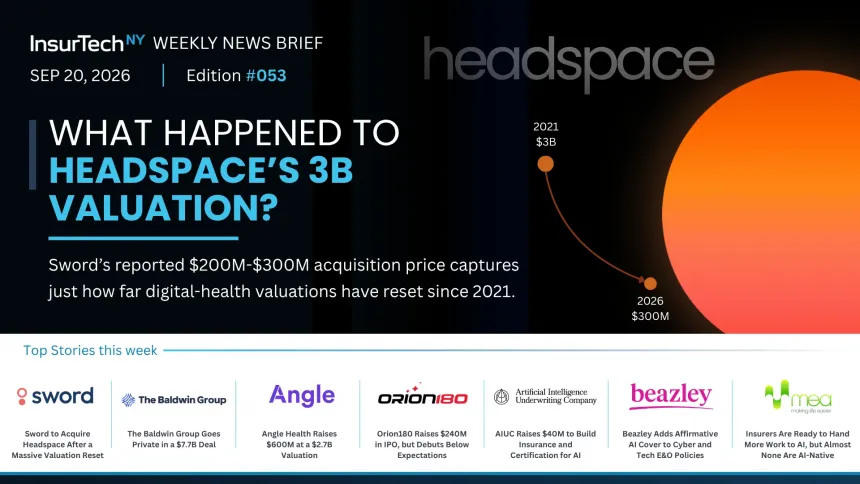
Sword to Acquire Headspace After a Massive Valuation Reset
Sword signed an agreement to acquire Headspace, bringing the mental
health platform into Sword’s broader AI Care offering across physical
health, women’s health, cardiometabolic care and mental health.
Sword did not disclose the purchase price. However, Axios previously
reported that the transaction was expected to value Headspace at roughly
$200 million to $300 million.
That compares with the approximately $3 billion valuation attached to
Headspace Health when Headspace and Ginger merged in 2021.
Source:
Sword
•
Axios
Take-Private
The Baldwin Group Goes Private in a $7.7B Deal
The Baldwin Group entered into a definitive agreement to be acquired by
an entity formed by Sequence Holdings and DFO Management, the Dell family
office, in a transaction valued at approximately $7.7 billion.
Shareholders will receive $32.50 per share in cash, while eligible
employees will retain a significant minority stake in the privately held
business following the transaction.
Baldwin said the new ownership structure is intended to provide
long-duration capital and greater flexibility to invest in technology,
software and AI without the same short-term public-market pressures.
Source:
The Baldwin Group
•
Reuters
Funding
Angle Health Raises $600M at a $2.7B Valuation
Angle Health announced $600 million in equity financing at a $2.7 billion
valuation.
The transaction consists of a $200 million Series C financing led by
Vitruvian Partners and a $400 million tender offer providing liquidity
to existing shareholders.
Angle says it now serves more than 5,000 employers across 47 states and
has delivered four consecutive quarters of profitability.
Source:
Angle Health
IPO
Orion180 Raises $240M in IPO, but Debuts Below Expectations
Orion180 Insurance priced its initial public offering at $12 per share,
below its marketed range of $15 to $17, raising approximately
$240 million.
The homeowners insurer began trading on Nasdaq under the ticker OIG.
Its shares fell in their market debut, valuing the company at roughly
$1.14 billion.
The offering provides another useful test of investor appetite for
insurance businesses approaching the public markets after several years
of volatile InsurTech valuations.
Source:
Reuters
Funding
AIUC Raises $40M to Build Insurance and Certification for AI
Artificial Intelligence Underwriting Company raised $40 million in
Series A funding led by Ribbit Capital, with participation from
First Harmonic and Terrain.
The round brings AIUC’s total funding to $55 million. The company is
building audits, standards and insurance infrastructure intended to help
enterprises deploy AI systems with greater confidence.
Its AIUC-1 standard tests AI agents against risks including jailbreaks,
hallucinations and data leakage, while the company plans to expand its
framework from agents toward frontier AI models.
Source:
AIUC
Cyber Insurance
Beazley Adds Affirmative AI Cover to Cyber and Tech E&O Policies
Beazley introduced affirmative AI wording across its cyber and
technology errors and omissions policies.
The wording explicitly confirms that covered cyber attacks remain
covered whether or not AI is involved, while also clarifying how
AI-related exposures are treated within existing protection.
The move comes as insurers increasingly have to distinguish between
traditional cyber losses, AI-assisted attacks and risks created by the
deployment of AI systems themselves.
Source:
Reinsurance News
Industry Research
Insurers Are Ready to Hand More Work to AI, but Almost None Are AI-Native
New research from ISG, commissioned by mea Platform, found that
83% of the global insurance market would support AI executing repeatable
operational work.
However, 75% said they would only allow that work to be performed using
insurance-specific models or systems governed by their own rules.
Fewer than 1% of respondents currently operate on a fully AI-native basis.
The research spans underwriting, operations, claims, technology and
transformation and highlights the gap between insurers’ appetite for
automation and their readiness to let AI execute processes end to end.
Source:
mea Platform
•
Reinsurance News