

The Dominoes Have Fallen
For decades, the captive agency model was one of the defining features of the property and casualty insurance industry. Carriers built national brands by recruiting agents, training them, assigning territories, and giving them a single product shelf to sell.
That model helped create generations of insurance professionals. It also gave carriers direct control over how their products reached consumers. Today, that model is under pressure.
The Trend Started Years Ago
Many observers have framed State Farm’s recent changes to agent compensation and benefits as another example of artificial intelligence disrupting insurance distribution.
That explanation is incomplete.
The trend predates modern generative AI by several years.
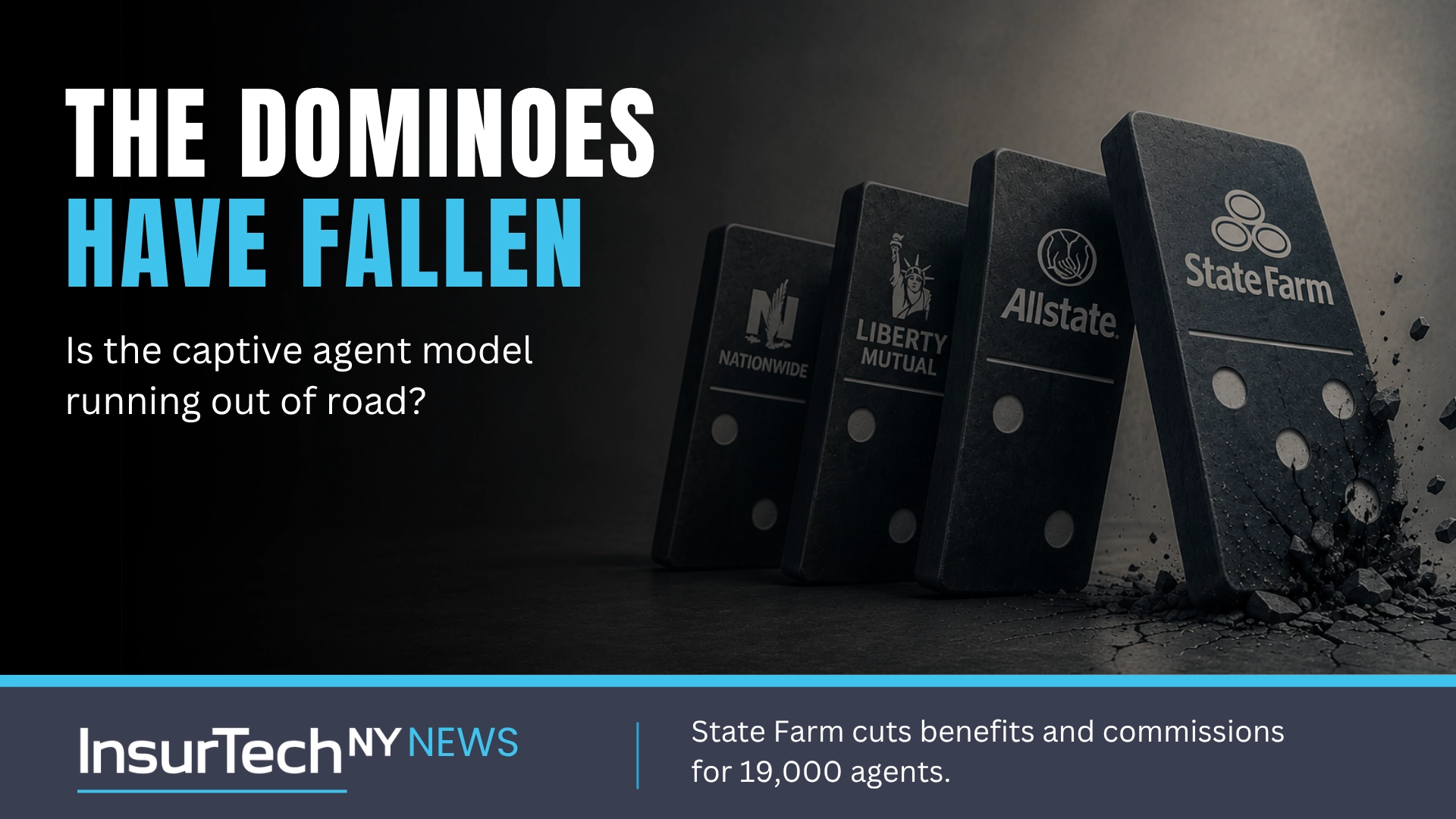
- June 2020: Nationwide ends its captive agent program.
- November 2021: Liberty Mutual transitions captive agents to independent agencies.
- January 2023: Allstate signals a reduction in captive distribution.
- June 2026: State Farm reduces benefits and commissions for captive agents.
Viewed individually, each decision can be explained by company-specific circumstances. Viewed together, they reveal something larger: carriers are increasingly questioning whether exclusive distribution remains the optimal model for growth.
Why Captive Distribution Is Under Pressure
The captive model was designed for a different era of insurance.
Historically, carriers benefited from controlling both manufacturing and distribution. Products were sold through dedicated agents who represented a single carrier and operated within defined territories.
Today’s market looks different.
Consumers can purchase insurance through direct channels, comparison platforms, embedded insurance experiences, independent agencies, affinity groups, digital marketplaces, MGAs, and increasingly AI-powered interfaces.
Carriers want the flexibility to pursue all of these opportunities simultaneously. Exclusive distribution creates natural channel conflict when a carrier wants to experiment with new distribution strategies.
The Structural Challenges
Several structural realities make the captive model increasingly difficult to maintain.
- Stranded in failing markets: Captive agents were assigned territory in regions that no longer work for them. In parts of South Florida and wildfire-exposed California, homes have become effectively uninsurable due to climate change. In other states, auto business isn’t worth writing because regulators won’t approve adequate rate or provide tort reform to protect carriers against personal injury attorneys.
- Growth of specialty markets: Roughly 10-15% of the P&C market now sits in E&S lines. Most captive agents don’t hold wholesale lines licensure and aren’t positioned to write E&S business.
- No way to offload bad risks: A carrier is often better off when a risk it doesn’t want lands on a competitor’s paper rather than its own book. Independent agents can do that and still keep the customer and the commission. Captive agents can’t — the risk is simply lost.
- Channel expansion: Carriers increasingly want access to direct, embedded, MGA, affinity, and technology-enabled distribution models.
None of these pressures were created by AI. Most existed long before ChatGPT entered the market.
Why State Farm Matters
Unlike some of its peers, State Farm has remained deeply committed to the captive model.
That is why its recent decision has attracted so much attention.
For State Farm, the timing appears tied as much to profitability as distribution strategy.
According to Carrier Management reported results, the company has faced significant underwriting pressure over the past several years.
- Auto Combined Ratio: 117.3% (2023), 104% (2024), 94% (2025)
- Homeowners and Commercial Combined Ratio: 115% (2023), 110% (2024), 108% (2025)
While results have improved, they remain above the levels achieved by some competitors. Progressive, for example, reported an 87% combined ratio across all lines in 2025.
In that context, distribution efficiency becomes more than a strategic preference. It becomes a financial necessity.
What Are The Takeaways?
Three lessons stand out.
- The captive agent model is unlikely to remain dominant forever. Agents should think carefully about how ownership, flexibility, and long-term economics fit into their career plans.
- AI is not the primary cause of this shift. Technology may accelerate change, but the structural pressures on captive distribution existed long before generative AI.
- Carriers need distribution flexibility. Future winners will likely participate across multiple channels, including independent agents, embedded distribution, direct channels, specialty programs, and MGAs.
The insurance industry spent decades building around captive distribution. The next decade may be defined by what comes after it.
Where MGA Lab Fits
One implication is clear: carriers need more ways to access new products, new risk segments, and new distribution models.
That is part of why InsurTech NY built the MGA Lab. The program supports startups working to launch and scale specialty insurance products, while connecting them with mentorship, capacity, and distribution expertise.
Applications are currently open for startups. Carriers, independent agencies, and experienced insurance professionals who want to support the next generation of insurance builders can also get involved as mentors.
To learn more, reach out to contact@insurtechny.com.