The MGA market is attracting a new generation of insurance entrepreneurs.
This year, we saw that shift firsthand.
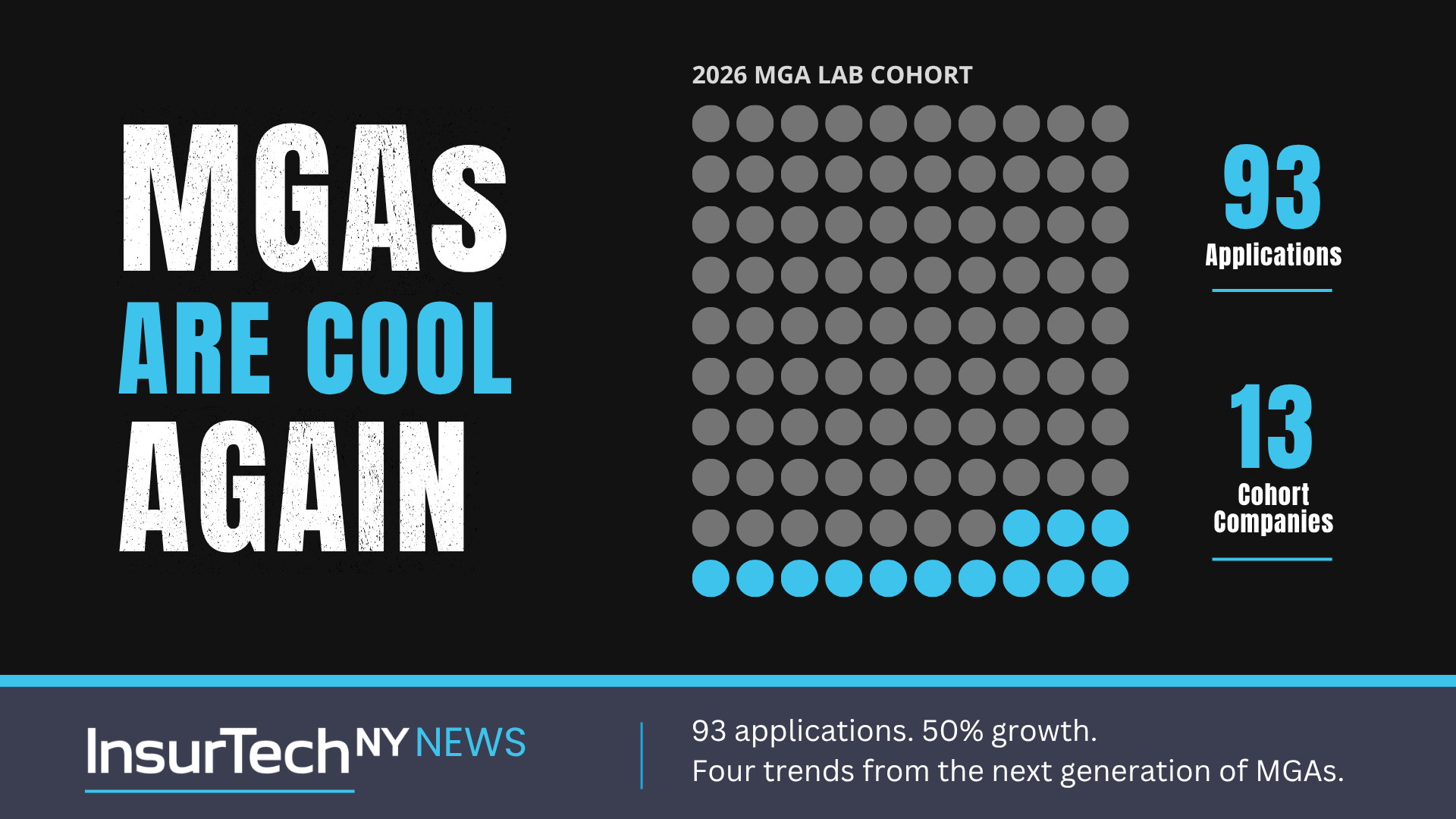
A record 93 companies applied for the 2026 InsurTech NY MGA Lab, up 50% from the previous year. From that group, 13 companies were selected for the new cohort.
The headline is the volume of applications. The more interesting story is what founders are choosing to build.
Across the applicant pool, we saw entrepreneurs targeting emerging risks such as artificial intelligence, finding overlooked niches inside mature markets like auto insurance, and applying increasingly specialized data to underwriting problems that have historically been difficult to price.
We also saw founders arriving from very different directions. Experienced underwriters are building technology-enabled MGAs. Technologists are learning how to turn new data and distribution models into insurance businesses. And while most activity remains concentrated in commercial P&C, a smaller number of founders are still pushing into life and health.
The 2026 MGA Lab cohort reflects that breadth. Its 13 companies span AI liability, management liability, construction, manufacturing, marine, commercial property, taxi and rideshare insurance, life insurance, environmental liability, travel, personal auto, and student transportation.
Taken together, they offer a useful snapshot of where MGA formation is heading.
93
Applications received
+50%
Year-over-year increase
13
Companies selected
9
AI liability applications
What is the InsurTech NY MGA Lab?
The InsurTech NY MGA Lab is an accelerator designed specifically for founders building, launching, or scaling Managing General Agents.
An MGA is not simply another kind of startup.
Founders may need to develop an underwriting thesis, secure insurance capacity, establish distribution, navigate regulation, build relationships with carriers and reinsurers, and demonstrate that the underlying insurance business can produce sustainable results.
Technology can help with all of those things. But technology alone is not enough.
That is why MGA Lab brings founders together with experienced insurance executives, underwriters, actuaries, capacity providers, brokers, investors, and other industry specialists.
The goal is not simply to help startups become better startups.
It is to help them become better insurance businesses.
This year’s application numbers suggest there are more founders than ever trying to do exactly that.
Why are more founders building MGAs?
Every successful MGA needs an edge.
Sometimes that edge is proprietary data. Sometimes it is specialized underwriting expertise, access to a difficult customer segment, a novel distribution channel, or a better understanding of a particular risk.
The MGA structure gives entrepreneurs a way to concentrate those advantages around a specific insurance problem without having to build a full-stack carrier from day one.
That makes the model particularly well suited to markets where specialization matters.
Our 2026 applications pointed to four trends.
Artificial intelligence was not simply part of the technology stack this year.
Increasingly, it was the risk being insured.
MGA Lab received nine applications focused on AI liability, making it one of the clearest emerging themes in the applicant pool.
As companies deploy autonomous and semi-autonomous AI systems, questions around responsibility become harder.
What happens when an AI agent makes a costly decision? Who is responsible when an automated system gives incorrect advice, causes financial loss, generates harmful content, or acts beyond the expectations of the business that deployed it?
Those scenarios do not always fit comfortably inside traditional liability products.
That creates room for insurers and MGAs capable of understanding the behavior, deployment, and underlying risks of AI systems in a more granular way.
One company selected for the cohort, Ollive, is building purpose-built liability insurance for AI agents and applications.
AI liability is still an early market. But nine applications in a single MGA Lab cycle is a meaningful signal that founders increasingly believe it can become a distinct insurance category.
Auto insurance is not new.
The opportunity may lie in serving the parts of it that broad-market products do not serve particularly well.
Several applicants approached auto through narrowly defined customer groups or operating models.
Three members of the 2026 cohort demonstrate just how different those niches can be.
TaxiFair has built experience in taxi insurance in Ireland and is now preparing to bring that model to New York for taxi and rideshare drivers.
LOOP is focused on personal auto and seeks to price customers without relying heavily on long-standing credit histories.
Shuttlebee approaches commercial auto through student transportation, combining transportation operations, risk-prevention technology, and underwriting.
None of these companies is trying to reinvent the idea of auto insurance.
Instead, each starts with a more specific question:
Can we understand and serve this group of drivers better than a generalist insurer can?
That same pattern appears across several other categories in the cohort.
One of the more interesting findings from this year’s applications was the background of the founders themselves.
Experienced insurance professionals and technologists were roughly equally likely to apply to build an MGA.
That matters because modern MGA formation increasingly demands capabilities from both worlds.
Insurance experience helps founders recognize where existing products, pricing assumptions, underwriting practices, or distribution models are falling short.
Technology can create access to new datasets, automate manual processes, improve risk selection, or make previously uneconomic niches viable.
The opportunity often sits between the two.
Some founders are experienced insurance operators applying new technology to familiar risks. Others are technology entrepreneurs building around new data sources and then developing the underwriting capabilities required to turn those insights into insurance products.
The best MGA businesses may increasingly be built by teams capable of doing both.
One part of the market was noticeably quieter.
Life & Health represented less than 10% of MGA Lab applications.
That is a stark contrast with liability, property, and auto, where founders identified numerous specialized opportunities.
There are plenty of possible explanations. Product development cycles can be different. Distribution is different. Regulation and capital requirements can present different barriers.
What the application data tells us more clearly is simply that fewer entrepreneurs are currently choosing to build there.
The final cohort nevertheless includes two companies exploring the category.
Kaleido Life is developing a model that gives customers access to a portion of their death benefit while they are still alive.
Halo is building around life insurance and tax-advantaged investment products.
Their inclusion illustrates an important point: lower startup activity does not necessarily mean lower potential.
Sometimes it means the barrier to creating something new is higher.
2026 MGA Lab
Meet the 2026 MGA Lab Cohort
The companies selected this year span established insurance markets alongside categories that barely existed a few years ago. What connects them is not one technology or business model. It is specialization.
13 companies
Multiple insurance categories
One MGA Lab cohort
AI Liability
Ollive
Ollive is building purpose-built liability insurance for AI agents and applications, addressing a new class of risk as autonomous systems take on increasingly consequential business functions.
Management & Specialty Liability
Ardiga
Ardiga is developing an intelligence-driven specialty underwriting platform that uses observable litigation signals to inform risk decisions in long-tail liability lines.
Construction Risk
Trajan
Trajan is building an AI-driven approach to construction risk, including a shared nationwide database designed to support distribution, technical underwriting, and ongoing policy and portfolio monitoring.
Manufacturing & CPG
GDS Insured
GDS Insured combines underwriting expertise with operational data to assess manufacturing risks that the company believes traditional approaches do not adequately capture.
Recreational Boating
UltraMarine InsurTech
UltraMarine uses IoT and AI to combine vessel-usage data with waterway and weather hazards, creating a more dynamic approach to assessing private marine risk.
Commercial Property
InsureMEP
InsureMEP focuses on the mechanical, electrical, plumbing, fire, and life-safety systems inside commercial buildings, digitizing infrastructure that can materially affect property risk.
Taxi & Rideshare
TaxiFair
TaxiFair is an established Irish taxi insurance broker operating on delegated authority. It plans to bring that experience to New York through an MGA focused on taxi and rideshare drivers.
Whole Life Insurance
Kaleido Life
Kaleido Life is rethinking how policyholders access life insurance benefits by enabling customers to receive a portion of the death benefit while still living.
Environmental Liability
Telluscope
Telluscope is developing an AI-native MGA for environmental liability, with a focus on subsurface risks including contamination, pollution, underground assets, regulatory exposure, and climate-related risk.
Parametric Travel Protection
LayoverGuard
Developed by Kaleta Labs, LayoverGuard is a fixed-payout, parametric-style travel product for passengers making self-transfer connections on separate airline tickets. Flight data determines whether predefined disruption conditions have been met.
Variable Universal Life
Halo
Halo combines life insurance with a tax-advantaged investment proposition, bringing a different product approach to one of the least represented categories in this year’s applications.
Personal Auto
LOOP
LOOP is building personal auto insurance for drivers in high-priced ZIP codes, including customers without long-standing credit histories.
Student Transportation
Shuttlebee
Shuttlebee combines student transportation, risk-prevention technology, and commercial auto underwriting. The company operates smaller vehicles for student transport while working to manage the underlying risk through its own insurance program.
What the applications tell us
What 93 MGA applications tell us about insurance innovation
There is no single template for the next generation of MGA.
Some companies begin with underwriting expertise. Others begin with technology.
Some have proprietary data. Others have access to customers that incumbent insurers struggle to reach efficiently.
But across the application pool, one characteristic appeared again and again:
specialization.
The traditional InsurTech question
What can technology do better?
The MGA question
What risk can you understand and underwrite better?
That shift is important.
The most compelling companies in this year’s applicant pool were not simply using AI, data, or automation because those technologies were available. They were applying them to narrowly defined insurance problems where better information, better distribution, or better underwriting could produce a meaningful advantage.
That is one reason the MGA model remains so attractive.
It allows founders to start narrow.
A company does not have to solve insurance broadly. It can build deep expertise in one class of risk, one customer segment, one geography, or one distribution channel.
If that expertise produces better underwriting results, the niche can become a business.
The 93 applications we received this year suggest more entrepreneurs are seeing that opportunity.
The 13 companies joining MGA Lab now have the harder task ahead of them:
proving that their ideas can become durable insurance businesses.
What happens next
Over the course of MGA Lab, founders will work with members of the insurance industry to pressure-test their underwriting assumptions, sharpen their distribution strategies, understand capacity requirements, and build the relationships required to bring new insurance products to market.
For some, the work will involve refining an existing MGA.
For others, it will mean turning an early product concept into an insurance business capable of securing the right partners.
That distinction is important.
The goal of MGA Lab is not to accelerate companies toward growth at any cost.
It is to help founders build insurance businesses that can earn the confidence of customers, distributors, and capacity providers.
We are looking forward to seeing how this year’s cohort develops.
Interested in the next MGA Lab cohort?
Applications for the 2026 cohort are closed, but MGA Lab will return.
Subscribe to InsurTech NY News
to hear when the next application cycle opens.